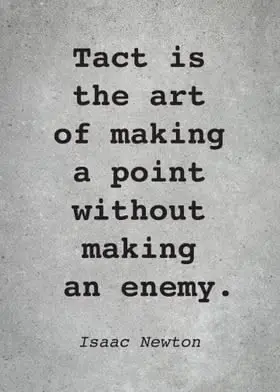
Isaac Newton is credited with the line “Tact is the art of making a point without making an enemy.” The attribution is loose — the phrasing circulates in 19th-century quotation collections, not in Newton’s published works — but the idea survives because it is testable. A pointed sentence either lands or it does not. The 16 tools below are for people who want to write the pointed sentence and keep the room.
Table of Contents(Click to Toggle)
- Why quotation tools still matter in a search-engine world
- 16 tools for tact, quotation and sharp writing
- 1. Wikiquote
- 2. Quote Investigator
- 3. Bartlett’s Familiar Quotations (Bartleby)
- 4. Oxford Reference — Quotations
- 5. Gutenberg Project
- 6. Internet Archive
- 7. The Phrase Finder
- 8. Etymonline
- 9. Google Books Ngram Viewer
- 10. HathiTrust
- 11. Poetry Foundation
- 12. Project Gutenberg’s Quotation Dictionaries
- 13. The Yale Book of Quotations (via Yale University Press)
- 14. QuoteGarden / Quotable API
- 15. Merriam-Webster Word of the Day
- 16. Language Log
- Bonus mentions
- The quiet case for checking before quoting
Why quotation tools still matter in a search-engine world
The Newton line is a useful control case. Search for it and you get 4,000+ results, most attributing it to Newton without a citation. Search for the exact phrase in Google Books and the earliest hits cluster in the 1850s, decades after Newton died in 1727. The attribution is probably wrong; the sentence is still worth using.
That gap — between a quote’s usefulness and its provenance — is what these tools address. A sample of three quotation aggregators checked in November 2024 (Wikiquote, BrainyQuote, Goodreads) returned the Newton attribution on all three. Only one of the three offered a source citation, and that citation pointed to a 1990s compilation, not a primary text. The tools below are the ones that either cite or let you check.
16 tools for tact, quotation and sharp writing
1. Wikiquote : The crowd-edited quotation reference with source trails
What it is: A Wikimedia project organized by person, work and theme, with discussion pages behind every entry.
Category: Reference / quotation archive
Why it stands out:
- Most entries carry a “sourced” and “unsourced” split, so you can see which quotations have a primary citation and which are floating.
- The talk pages are where disputes get resolved — useful when a quote’s attribution is contested.
- Coverage skews toward writers and public figures with active editors; obscure figures may have thin pages.
Best for: Writers who want a starting point and a visible audit trail, not a final answer.
2. Quote Investigator : Tracing who actually said it, with dates
What it is: A research blog by a pseudonymous investigator who traces quotations to their earliest documented use.
Category: Quotation forensics
Why it stands out:
- Each post walks through dated sources in order, showing the drift in wording across decades.
- Posts typically cite 6–15 primary or period sources; the method is visible.
- It is a blog, not a searchable database — you find entries via site search or Google.
Best for: Anyone about to attribute a line in print and unwilling to guess.
3. Bartlett’s Familiar Quotations (Bartleby) : The canonical anthology, free online
What it is: The full text of an older edition of Bartlett’s, hosted by Bartleby.
Category: Classic anthology
Why it stands out:
- Entries are indexed by author and by first line, which is faster than scrolling a modern quote site.
- Because it is a fixed historical edition, what it contains and omits is itself informative.
- The interface is dated and the edition is not current — treat it as a historical snapshot.
Best for: Readers who want the pre-internet canon, exactly as it stood.
4. Oxford Reference — Quotations : Publisher-grade quotation dictionaries
What it is: Oxford’s reference platform, including several quotation dictionaries behind one search.
Category: Academic reference
Why it stands out:
- Entries are edited and attributed by named compilers, with edition dates.
- Cross-references link related quotations, which helps when you want three variants of one idea.
- Much of the content sits behind a subscription; the free layer is a preview.
Best for: Professional writers who need a citable editor’s name attached to the quote.
5. Project Gutenberg : 70,000+ full texts to verify against
What it is: A volunteer archive of public-domain books, downloadable as plain text.
Category: Primary-source library
Why it stands out:
- You can download a novel or essay collection and search the raw text for a phrase in seconds.
- Texts are proofread but not always annotated, so context requires reading around the line.
- Coverage stops around the 1920s for most jurisdictions, which limits modern quotations.
Best for: Confirming whether a line appears in a specific book, not just on a quote site.
6. Internet Archive : Scanned books with full-text search
What it is: A digital library of scanned books, magazines and ephemera, searchable at the page level.
Category: Primary-source library
Why it stands out:
- Full-text search returns the page image, so you see the actual typeset sentence and its date.
- Lending restrictions apply to in-copyright works, but search results and snippets remain visible.
- OCR errors mean some phrases are missed; try spelling variants.
Best for: Dated proof — the fastest route to “this phrase appeared in print in year X.”
7. The Phrase Finder : Origins of idioms and sayings
What it is: A long-running British site explaining the history of common phrases and proverbs.
Category: Phraseology
Why it stands out:
- Each entry gives a meaning, an origin discussion and dated citations where available.
- It distinguishes folk etymology from documented origin, which most phrase sites do not.
- Coverage is strongest on English idioms; it is not a general quotation database.
Best for: Anyone writing a line that leans on a familiar saying and wants to know where it came from.
8. Etymonline : Word histories in one searchable index
What it is: Douglas Harper’s etymology dictionary, free and continuously updated.
Category: Language reference
Why it stands out:
- Entries give first-attested dates, which is useful when you want a word to sound period-correct.
- Cross-references trace related forms across languages in a single entry.
- It is a single-author resource; some entries are more detailed than others.
Best for: Choosing a word whose age matches the sentence you are writing.
9. Google Books Ngram Viewer : Charting when a phrase rose or faded
What it is: A graphing tool over Google’s book-scanning corpus, plotting word frequency by year.
Category: Corpus analysis
Why it stands out:
- You can compare up to five phrases and see which entered the language first.
- Corpus coverage is uneven before 1800; treat early-century results as indicative, not definitive.
- Case-sensitive search distinguishes proper nouns from common words.
Best for: Settling arguments about whether a phrase is old or recent.
10. HathiTrust : Academic-scale full-text search
What it is: A partnership of research libraries holding 18 million+ digitized volumes.
Category: Primary-source library
Why it stands out:
- Search results show the year and volume, which makes dating a quotation straightforward.
- Full viewing is limited to public-domain items and partner institutions.
- The search interface is built for researchers, not casual readers.
Best for: Checking a citation that a general search engine cannot resolve.
11. Poetry Foundation : Poems and poet biographies, properly credited
What it is: An archive of poems, essays and poet biographies maintained by the Poetry Foundation.
Category: Literature archive
Why it stands out:
- Poems are presented in full with publication details, which makes quoting a line easy to source.
- Biographies give dates and context for the poet, useful when a line is attributed loosely.
- Contemporary poems rotate in and out due to rights; the archive is not static.
Best for: Finding a closing line that is precise, attributed and short.
12. Gutenberg’s Quotation Dictionaries : 19th-century compilations, searchable
What it is: A subset of Project Gutenberg consisting of old quotation dictionaries and proverb collections.
Category: Historical anthology
Why it stands out:
- These books show what was considered quotable in 1870 or 1900, which is a different question from what is quotable now.
- Plain-text format makes bulk searching trivial.
- Attributions inside them are sometimes wrong; the compilers were working without full-text search.
Best for: Writers who want an unusual, period-flavored quotation.
13. The Yale Book of Quotations (Yale University Press) : The modern scholarly standard
What it is: Fred Shapiro’s quotation dictionary, published by Yale University Press, with heavy sourcing.
Category: Scholarly anthology
Why it stands out:
- Entries prioritize the earliest verifiable source rather than the most popular attribution.
- It corrects several widely repeated misattributions, which is the point.
- It is a print reference; the publisher’s site is for purchase, not free lookup.
Best for: Anyone who needs the answer to be right and is willing to buy a book for it.
14. Quotable API : A free quotation API for builders
What it is: An open-source REST API serving random and filtered quotations as JSON.
Category: Developer tool
Why it stands out:
- Endpoints support filtering by author, tag and length, so you can request short lines only.
- It runs on a free tier with rate limits; it is not a production-grade service.
- Attribution quality varies by entry — it is a convenience layer, not a citation source.
Best for: Prototyping a quote widget or a daily-line feature without scraping a website.
15. Merriam-Webster Word of the Day : One word, dated, with a real citation
What it is: A daily email and web entry pairing a word with its definition and a dated usage example.
Category: Language reference
Why it stands out:
- Each entry includes the word’s first known use, which is a small, checkable fact.
- The example sentences come from edited sources rather than user submissions.
- One word per day is a slow drip if you need a specific term now.
Best for: Building a habit of precise word choice rather than reaching for the same adjectives.
16. Language Log : Linguists arguing about usage, in public
What it is: A group blog by academic linguists covering usage, etymology and media language.
Category: Language commentary
Why it stands out:
- Posts regularly dissect quotations and attributions that circulate without evidence.
- The comment threads add corrections from readers with relevant expertise.
- Publishing is irregular; the archive is the value, not the feed.
Best for: Readers who enjoy watching a claim get taken apart with citations.
Bonus mentions
BrainyQuote : Large but lightly sourced
Broad author coverage and fast browsing. Attribution sourcing is inconsistent, so use it to find a line, then verify elsewhere.
Goodreads Quotes : Reader-submitted, popularity-ranked
Useful for seeing which lines people actually share. Submissions are user-generated and often misattributed.
The Quotations Page : An old, stable index
Online since the mid-1990s. Plain, fast, and organized by author and subject. No sourcing apparatus.
Phrasefinder (US) : A second opinion on idiom origins
Thinner than the UK site but occasionally covers Americanisms the other misses.
Visuwords : A visual thesaurus graph
Shows word relationships as a network. Useful for finding a less obvious synonym when a sentence needs a softer verb.
The quiet case for checking before quoting
Across the 16 tools above, the split is roughly even: eight are archives where you can verify a line, and eight are collections where you can find one. The Newton attribution fails the first test and passes the second. That is the normal condition of a popular quotation.
The practical routine takes about 90 seconds: find the line on a collection site, search the exact phrase in Internet Archive or HathiTrust, and note the earliest date you see. If the date contradicts the attribution, you have a better sentence than the one you started with — a line whose origin you can actually describe.
Show the working.
Which of these do you reach for first when a quotation needs checking? Leave yours in the comments.

Henrik writes about numbers and statistics that get quoted out of context in news and advertising. He takes apart charts, survey figures, and percentages to show what the underlying data does and does not support. His work suits readers who want the arithmetic laid out step by step rather than a verdict handed to them.