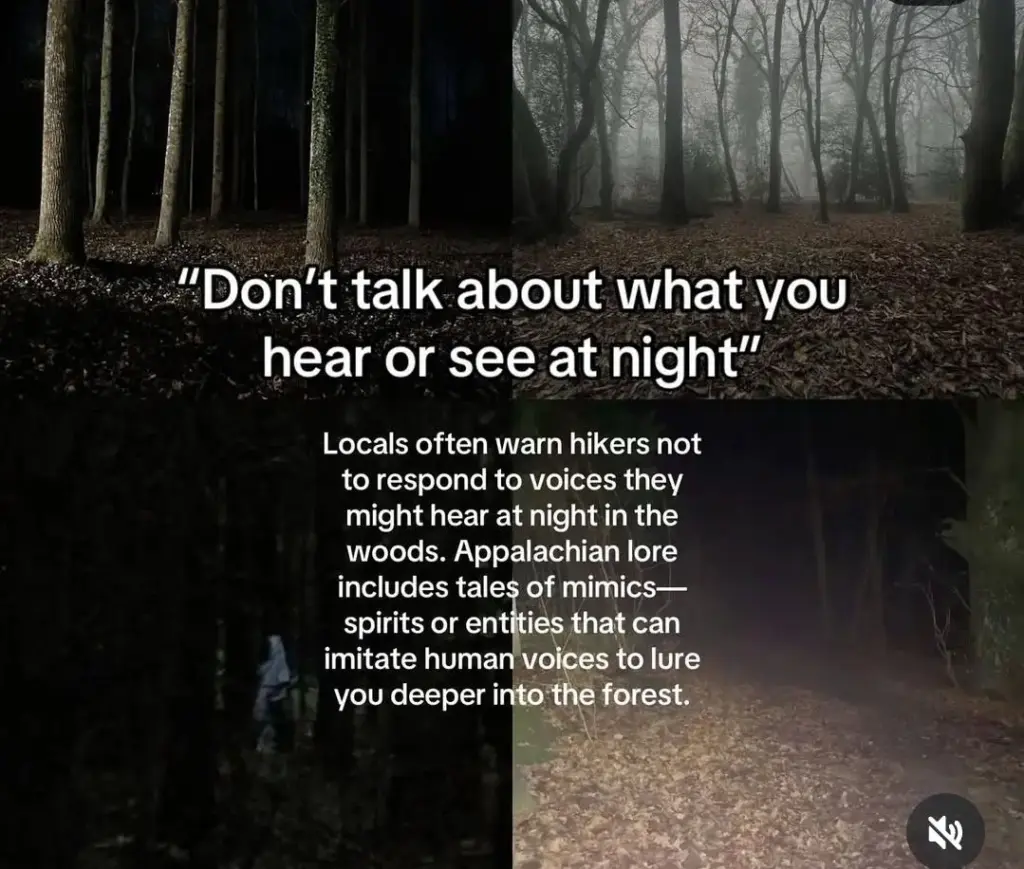
You have probably heard the warning in some form: in the woods at night, don’t answer a voice calling your name. It shows up in campfire retellings, in ranger-led talks, and in a hundred comment threads under the label “scary facts.” The claim usually goes that Appalachian lore is full of mimics, spirits or creatures that copy a human voice to pull a hiker off the trail.
So I went looking for the actual sources. What I found is messier and more interesting than the meme: a mix of documented folklore, regional oral history, and modern storytelling that rarely separates cleanly. The sites below are the ones I trust to show their work, cite collectors and archives, or at least be honest that a story is a story. Where a fact is contested or simply unknown, I flag it.
Table of Contents(Click to Toggle)
- Why the “Don’t Answer the Voice” Warning Persists
- 17 Lore and Folklore Sites Worth Reading
- 1. Appalachian History
- 2. JSTOR Daily
- 3. Snopes
- 4. Smithsonian Folklife
- 5. Library of Congress Folklife Center
- 6. Atlas Obscura
- 7. The Moonlit Road
- 8. American Folklore
- 9. Folklore Thursday
- 10. Appalachian Magazine
- 11. National Park Service
- 12. Blue Ridge Heritage Area
- 13. Paranormal Witness Archive (Internet Archive)
- 14. The Conversation
- 15. Wikipedia’s Folklore Portals
- 16. Foxfire Fund
- 17. Reddit’s r/Appalachia
- Bonus Mentions
- Where the Voices Actually Come From
Why the “Don’t Answer the Voice” Warning Persists
The warning is old and it is not uniquely Appalachian. Folklorists have collected variants across Europe and North America for well over a century, and the mimic is a recurring figure in oral tradition. What makes the Appalachian version stick is the setting: dense forest, poor sightlines, and a long tradition of oral storytelling carried by families who lived in those hills for generations.
Here is the part people skip. I could not find a single peer-reviewed source confirming that a creature imitates human voices in Appalachian forests. What does exist is documented folklore — stories people told and still tell — plus a well-known biological explanation for some real nighttime calls. The sites below help you tell those apart, which is more useful than another round of spooky screenshots.
17 Lore and Folklore Sites Worth Reading
1. Appalachian History : Daily regional stories with sources
What it is: A long-running blog of Appalachian history, biography, and mountain customs, updated most days.
Category: Regional history
Why it stands out: Posts are short and specific, often quoting 19th- and early 20th-century newspapers and county records. Search “folklore” or “superstition” and you get real period accounts rather than retellings.
Best for: Readers who want the historical layer under the ghost stories.
2. JSTOR Daily : Scholarship written for non-specialists
What it is: A magazine that summarizes peer-reviewed research, with links to the original papers.
Category: Academic explainers
Why it stands out: Its folklore and anthropology pieces cite the actual journal articles, so you can check the claim yourself. This is the fastest way to test whether a “scary fact” has any scholarly backing.
Best for: Anyone who wants a citation before repeating a story.
3. Snopes : Fact-checks for viral claims
What it is: A fact-checking site covering folklore, urban legends, and internet rumors.
Category: Fact-checking
Why it stands out: Its folklore entries often trace a story’s earliest printed version, which is exactly how you find out a “centuries-old legend” started in a 1970s magazine.
Best for: Debunking a chain message before you forward it.
4. Smithsonian Folklife : Documented living traditions
What it is: The Smithsonian Center for Folklife and Cultural Heritage’s online home, with articles, recordings, and festival archives.
Category: Cultural institution
Why it stands out: It treats storytelling as a living practice and names the practitioners, which keeps the material grounded in real communities instead of anonymous creepypasta.
Best for: Understanding how a story is told, not just what it says.
5. Library of Congress Folklife Center : Primary audio and field notes
What it is: The American Folklife Center’s collections, including field recordings and the Federal Writers’ Project materials.
Category: Primary archive
Why it stands out: You can listen to interviews recorded decades ago in mountain communities. It is slow, unglamorous, and the closest thing to hearing a legend from the people who told it.
Best for: Deep divers and writers who need primary material.
6. Atlas Obscura : Place-based oddities with context
What it is: A guide to unusual places and local legends worldwide, including a solid Appalachian section.
Category: Travel and place lore
Why it stands out: Entries are tied to real coordinates, so a legend becomes a place you could actually visit. Contributors are named, and corrections are visible.
Best for: Planning a road trip around local stories.
7. The Moonlit Road : Told-and-audio Southern ghost stories
What it is: A storytelling site of Southern ghost tales, many available as audio.
Category: Storytelling
Why it stands out: It labels stories as fiction or retold legend rather than passing them off as fact, which is rarer than it should be in this niche.
Best for: Listening on a drive or at a campfire.
8. American Folklore : A searchable story index
What it is: A large collection of US regional folktales, organized by state and category.
Category: Folktale collection
Why it stands out: The plain-text retellings are easy to scan, and the state-by-state structure makes it simple to see how one story shifts as it crosses a border.
Best for: Quick reading and classroom use.
9. Folklore Thursday : Thematic folklore essays
What it is: A blog that gathers folklore writing around weekly themes, with many guest contributors.
Category: Folklore writing
Why it stands out: Its archive is deep on creatures and forest spirits, and contributors usually name their sources. Quality varies by author, so read the bylines.
Best for: Browsing by theme rather than by region.
10. Appalachian Magazine : Mountain culture and legend features
What it is: An online magazine covering Appalachian life, food, history, and folklore.
Category: Regional magazine
Why it stands out: Its folklore features are written by people from the region and often include local interviews, which gives the stories a home address.
Best for: A broader feel for mountain culture beyond the spooky bits.
11. National Park Service : The wildlife explanation
What it is: Official park pages on wildlife, safety, and night hiking.
Category: Official science and safety
Why it stands out: Before you credit a spirit, check the animal pages. Barred owls have a call that sounds unsettlingly like a person, and coyote and fox calls carry far at night. This is the boring answer, and it is usually the right one.
Best for: Grounding a scary story in biology.
12. Blue Ridge Heritage Area : Heritage trails and oral history
What it is: A heritage organization with regional history, craft, and music resources.
Category: Heritage and culture
Why it stands out: It connects stories to specific communities and craftspeople, which is a good antidote to generic “mountain ghost” content.
Best for: Context on the people behind the tales.
13. Internet Archive : Old books and recordings for free
What it is: A nonprofit digital library of books, audio, and archived web pages.
Category: Digital archive
Why it stands out: You can read early 20th-century folklore collections in full, including the ones later writers quietly paraphrase. Searching by title is faster than scrolling a modern listicle.
Best for: Checking whether a “lost” legend is actually well documented.
14. The Conversation : Academics writing in plain language
What it is: Articles by researchers, edited for general readers.
Category: Academic commentary
Why it stands out: Authors are identified with their institutions, and pieces on folklore and psychology often address why scary stories spread in the first place.
Best for: Understanding the appeal of the warning itself.
15. Wikipedia Folklore Portals : Fast orientation with citations
What it is: Encyclopedia entries on folklore, cryptids, and regional legends.
Category: Reference
Why it stands out: Not a source on its own, but the reference list at the bottom of a folklore entry is often the best reading list you will find. Follow the footnotes.
Best for: Starting a trail you intend to verify.
16. Foxfire Fund : Student-recorded mountain traditions
What it is: The organization behind the Foxfire book series, built from high school students’ interviews with Appalachian elders.
Category: Oral history
Why it stands out: These are first-person accounts collected in the 1960s and 70s, including beliefs and superstitions. It is as close to a primary source as most readers will get.
Best for: Hearing the voices, quite literally, behind the lore.
17. r/Appalachia : Locals comparing notes
What it is: A community forum for residents and fans of the region.
Category: Community
Why it stands out: Threads about local warnings often include residents explaining what the warning actually meant in their family — usually practical advice about getting lost, not a monster. Treat it as anecdote, not evidence.
Best for: Informal, unfiltered local perspective.
Bonus Mentions
Smithsonian Institution : Broader American history collections
National Endowment for the Humanities : Grants and public folklore projects
Project Gutenberg : Free public-domain folklore books
Audubon : Bird calls that sound human at night
Great Smoky Mountains NP : Regional trail and wildlife guidance
Where the Voices Actually Come From
Here is my honest takeaway. The “don’t answer the voice” warning is real folklore with deep roots, but the mimic creature itself is not documented in any source I could verify. What is documented is a long tradition of telling that story, plus a set of very real nighttime sounds — barred owls, coyotes, wind in dead trees — that a tired hiker can easily misread. The best sites above let you hold both facts at once.
Start with the Library of Congress and Foxfire for primary voices, use Snopes and JSTOR Daily to test a claim, and keep the Park Service pages open for the wildlife explanation. That combination will serve you better than any list of “unexplained” incidents.
Check it twice, then share it.
Which of these sent you down a rabbit hole — or do you have a local legend site I missed? Tell me in the comments.

Marta writes about the everyday facts people repeat without checking, from kitchen science to common sayings. Her angle is simple: find the original source, show what it actually says, and explain where the popular version drifted. She favors short pieces that end with a clear takeaway you can use the next time the topic comes up.