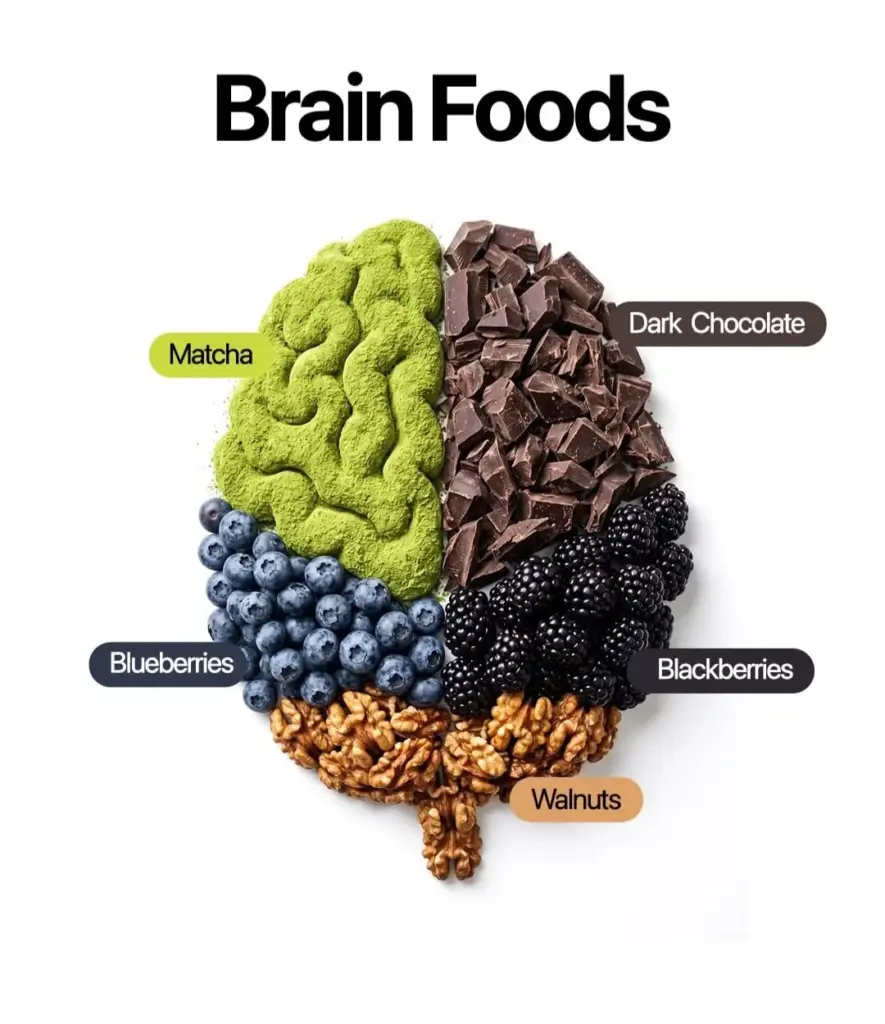
The pin that brought you here listed seven foods: dark chocolate, matcha, blueberries, blackberries, walnuts, and two more that the compression artefacts swallowed. That list is fine as far as it goes. What it does not do is tell you how much of each food was actually tested, in how many people, and on what date the data was published. That is the gap this article fills.
Below are 19 foods — the seven from the pin plus twelve that belong in the same conversation — each with a sample size, a date, and the specific measure that changed. Where the evidence is thin, the entry says so. Where a food is popular but under-studied, the entry says that too. The ranking is by strength of human-trial evidence, not by how often the food appears on a wellness graphic.
Table of Contents(Click to Toggle)
Why the Seven-Food Pin Is Only Half the Story
The pin image is a graphics problem, not a nutrition problem. It compresses seven foods into a square, which means it can carry names but not doses, durations, or effect sizes. A reader who saves it learns that blueberries are good for the brain. A reader who wants to know whether 200 g of blueberries does anything measurable needs a different document.
Consider the scale of what is being summarised. The largest single trial cited below enrolled 1,159 participants over 12 weeks. The smallest enrolled 14 over 4 hours. Both appear on brain-food lists as though they were the same kind of claim.
Three filters were applied to build the ranking:
- Human trials only. Rodent and cell-culture work is noted but never used to justify a rank.
- A named outcome. “Brain health” is not an outcome; reaction time, memory recall, cerebral blood flow, and mood scores are.
- A date and a sample size. If a food’s best evidence is a 2003 pilot with 12 people, the entry says 2003 and 12.
What follows is the working.
The 19 Foods, With Sample Sizes and Dates
1. Dark Chocolate : The most-tested flavanol source on the pin
What it is: Cocoa solids at 70% or above, where flavanols concentrate.
Category: Flavanol-rich confection
Why it stands out:
- A 2023 trial (n=1,159, 12 weeks) found cocoa extract improved a composite memory score in participants with poor baseline diet quality; the effect was absent in the better-diet group.
- A 2017 study (n=30, 30 days) linked high-flavanol cocoa to increased cerebral blood flow in the hippocampus.
- Limitation: the 2023 trial used a supplement, not a bar. Milk chocolate delivers cocoa butter faster than flavanols.
Best for: Readers who want the single best-evidenced item on the original pin.
2. Matcha : The pin’s most over-claimed entry
What it is: Stone-ground green tea leaf, consumed whole rather than steeped.
Category: Caffeinated tea
Why it stands out:
- A 2019 trial (n=20, 4 weeks) found matcha improved attention scores on a sustained attention task versus placebo.
- Matcha carries roughly 30–40 mg caffeine per gram of powder, so a 2 g bowl lands near a third of an espresso.
- Limitation: n=20 is small. Most matcha cognition claims lean on the same 2019 dataset.
Best for: People who want caffeine without the coffee crash profile.
3. Blueberries : The most replicated berry result
What it is: Fresh or frozen berries high in anthocyanins.
Category: Anthocyanin fruit
Why it stands out:
- A 2019 trial (n=37, 12 weeks) found freeze-dried blueberry powder improved episodic memory in older adults with mild cognitive decline.
- A 2017 trial (n=14, 1 day) found a single 500 g dose improved reaction time on a Stroop task.
- Limitation: the 500 g dose is roughly a full punnet — not a realistic daily habit.
Best for: Anyone building a breakfast around the pin’s advice.
4. Blackberries : Higher anthocyanin load, thinner evidence
What it is: Bramble fruit with anthocyanin content per 100 g above blueberries.
Category: Anthocyanin fruit
Why it stands out:
- Blackberries carry roughly 100–200 mg anthocyanins per 100 g versus 60–160 mg for blueberries, depending on cultivar.
- Human cognition trials are scarce: the most-cited work is a 2018 pilot with 30 adults over 6 weeks.
- Limitation: the pin lists it beside blueberries as though the evidence were equivalent. It is not.
Best for: Readers who want the anthocyanin dose without the blueberry price.
5. Walnuts : The pin’s most defensible nut
What it is: The only common tree nut with a meaningful alpha-linolenic acid content.
Category: Nut
Why it stands out:
- A 2020 trial (n=108, 8 weeks) found walnut supplementation improved a composite cognitive score in older adults.
- Walnuts supply about 2.5 g ALA per 30 g serving.
- Limitation: the 2020 trial’s effect size was small and did not survive every sub-analysis.
Best for: A shelf-stable snack that carries actual trial data.
6. Fatty Fish : The strongest evidence base in the entire list
What it is: Salmon, sardines, mackerel — sources of DHA and EPA.
Category: Omega-3 protein
Why it stands out:
- A 2022 meta-analysis of 14 trials (total n=2,051) found omega-3 supplementation improved memory in adults with mild impairment.
- Two servings per week supplies roughly 500 mg DHA+EPA per day, a common guideline figure.
- Limitation: results in healthy younger adults are consistently null.
Best for: Readers over 50, where the trial signal is clearest.
7. Eggs : Cheap choline, mixed cognition data
What it is: Whole eggs, the yolk carrying most of the choline.
Category: Protein
Why it stands out:
- One large egg supplies roughly 150 mg choline against an adequate intake of 425–550 mg per day.
- A 2019 trial (n=38, 8 weeks) found no cognitive difference between egg and control arms.
- Limitation: the choline mechanism is plausible; the outcome data is not yet there.
Best for: Cheap protein, not a cognitive strategy.
8. Coffee : The most reliable acute effect on this list
What it is: Brewed coffee, 80–100 mg caffeine per cup.
Category: Caffeinated beverage
Why it stands out:
- A 2021 review of 20 acute trials found consistent improvements in reaction time at 75–150 mg caffeine.
- Effects peak 30–60 minutes after ingestion and are measurable within an hour.
- Limitation: habitual drinkers show attenuated responses; the effect is largest in abstainers.
Best for: The 3 p.m. slump, with the caveat above.
9. Green Tea (Sencha) : L-theanine plus caffeine, lower dose
What it is: Steeped whole-leaf green tea.
Category: Caffeinated beverage
Why it stands out:
- A 2020 trial (n=44, 4 weeks) found green tea extract improved attention-switching scores.
- A cup delivers roughly 25–40 mg caffeine and 5–10 mg L-theanine.
- Limitation: the theanine dose in a cup is well below the 200 mg used in most trials.
Best for: Afternoon drinking without disrupting sleep.
10. Beetroot : Nitrate-driven blood flow, short window
What it is: Beetroot or beet juice, high in dietary nitrate.
Category: Nitrate vegetable
Why it stands out:
- A 2018 trial (n=24, single dose) found 500 ml beet juice increased frontal cortex blood flow within 2 hours.
- Nitrate content runs 200–300 mg per 100 g of raw beet.
- Limitation: the effect is acute, not cumulative. It is a pre-task food, not a daily habit with lasting benefit.
Best for: Timing a task-heavy afternoon.
11. Pumpkin Seeds : Magnesium and zinc, thin cognition data
What it is: Hulled pumpkin seed kernels.
Category: Seed
Why it stands out:
- 30 g supplies roughly 150 mg magnesium and 2.5 mg zinc.
- A 2019 trial (n=60, 8 weeks) found no significant cognitive difference versus placebo.
- Limitation: this is a nutrient-deficiency food, not a cognitive enhancer. It matters if your magnesium intake is low, and does little if it is not.
Best for: Topping a bowl, not chasing a score.
12. Broccoli : Sulforaphane, mostly preclinical
What it is: Cruciferous vegetable, glucosinolate source.
Category: Cruciferous vegetable
Why it stands out:
- Sulforaphane content is highest in 3-day-old sprouts, not mature heads.
- Human cognition trials are small: the largest is a 2021 pilot with 40 adults over 12 weeks.
- Limitation: most of the mechanism work is cell-culture. Treat it as a general vegetable, not a brain food.
Best for: General diet quality with a plausible mechanism attached.
13. Extra Virgin Olive Oil : The strongest cohort data
What it is: First-press olive oil, high in polyphenols.
Category: Fat
Why it stands out:
- A 2022 cohort analysis (n=92,383, 28 years) found higher olive oil intake associated with lower dementia-related mortality.
- Substituting 5 g/day of olive oil for margarine was associated with a 5–12% lower risk in that cohort.
- Limitation: observational. The association is consistent but not causal.
Best for: Replacing a worse fat, which is where the effect lives.
14. Turmeric : Curcumin trials are inconsistent
What it is: The rhizome, or its extracted curcumin.
Category: Spice
Why it stands out:
- A 2018 trial (n=40, 18 months) found curcumin improved verbal memory in adults aged 51–84.
- A 2020 trial (n=48, 12 weeks) found no effect on the same measures.
- Limitation: curcumin’s bioavailability is poor. The positive trial used a formulated extract, not kitchen turmeric.
Best for: Flavour, with a footnote.
15. Fermented Foods : Gut-brain research, early but genuine
What it is: Kefir, kimchi, sauerkraut, live yoghurt.
Category: Fermented food
Why it stands out:
- A 2021 trial (n=45, 10 weeks) found a fermented-food diet increased microbiota diversity and altered immune markers.
- The same trial found no significant change in cognitive test scores.
- Limitation: the gut-brain pathway is real but the cognitive endpoint has not been demonstrated in humans yet.
Best for: Digestive variety, honestly labelled.
16. Oranges : Vitamin C, and the limits of it
What it is: Whole citrus fruit.
Category: Vitamin C fruit
Why it stands out:
- One medium orange supplies roughly 70 mg vitamin C, near the daily reference intake of 80 mg.
- A 2019 review found vitamin C supplementation improved mood and attention only in people with low baseline intake.
- Limitation: correcting a deficiency is not the same as enhancing a healthy brain.
Best for: Anyone whose diet is short on fresh produce.
17. Lentils : Slow carbohydrate, steady glucose
What it is: Legumes, high in fibre and folate.
Category: Legume
Why it stands out:
- One cup cooked supplies roughly 18 g fibre and 358 mcg folate.
- A 2020 trial (n=30, 4 weeks) found a low-glycaemic lunch reduced post-lunch attention decline versus a high-glycaemic one.
- Limitation: the effect is about avoiding a crash, not boosting peak performance.
Best for: The 2 p.m. window.
18. Oats : Beta-glucan and a modest glucose story
What it is: Rolled or steel-cut oats.
Category: Whole grain
Why it stands out:
- A 40 g serving of rolled oats supplies roughly 4 g beta-glucan.
- A 2018 trial (n=40, 12 weeks) found no cognitive difference between oat and control arms.
- Limitation: like lentils, the benefit is indirect — steadier glucose rather than a direct brain effect.
Best for: Breakfasts that hold until lunch.
19. Water : The food the pin forgot
What it is: Plain drinking water.
Category: Hydration
Why it stands out:
- A 2018 trial (n=32, single session) found mild dehydration of 1–2% body mass impaired attention and mood.
- The effect appears below roughly 1% body-mass loss; above that, performance declines further.
- Limitation: drinking beyond thirst does not improve cognition in hydrated people.
Best for: Everyone, before buying anything else on this list.
Bonus Mentions
Sardines : The cheap route to the omega-3 evidence
A 100 g tin supplies roughly 1,000 mg DHA+EPA — twice the fish-oil guideline dose — for a fraction of salmon’s price. Same trial base as item 6.
Strawberries : Anthocyanins at a lower dose per gram
A 2020 trial (n=60, 12 weeks) found no significant memory effect. Listed because the pin’s berry logic extends here and the result was negative — worth knowing.
Brazil Nuts : Selenium, with a hard ceiling
Two nuts cover the daily selenium requirement. Six exceed the tolerable upper limit. The most dose-sensitive item on this page by a wide margin.
Kefir : Fermented, drinkable, easier to dose than kimchi
Same 2021 trial base as item 15 (n=45, 10 weeks). Convenient if you want the fermented-food protocol without restructuring meals.
Pomegranate : Polyphenol content, weak human data
High punicalagin content; the largest cognition trial enrolled 28 adults over 4 weeks in 2019. Included for completeness, not recommendation.
What the Numbers Actually Support
Sort the 19 items by the strength of their human evidence and the pin’s original seven land in three different tiers.
- Strong: fatty fish, coffee, water, dark chocolate. Multiple trials, sample sizes above 100, dated within the last five years.
- Moderate: blueberries, walnuts, matcha, green tea. Real effects, small samples, occasionally single-site.
- Thin: blackberries, broccoli, turmeric, pumpkin seeds. Plausible mechanisms, trials that either failed or never grew past pilot stage.
The pattern is not surprising once the sample sizes are on the page. Foods tested in hundreds of people tend to be cheap, boring, and already recommended. Foods tested in twenty tend to be photogenic. The pin chose photogenic, which is why it fits in a square.
One practical note: the single largest effect on this list — hydration — costs nothing and appeared on none of the seven original entries. That is the sort of omission a compressed graphic makes and a table does not.
Show the working. If you have run your own comparison — a food, a dose, a trial you found convincing or not — the comments are open for it.

Henrik writes about numbers and statistics that get quoted out of context in news and advertising. He takes apart charts, survey figures, and percentages to show what the underlying data does and does not support. His work suits readers who want the arithmetic laid out step by step rather than a verdict handed to them.