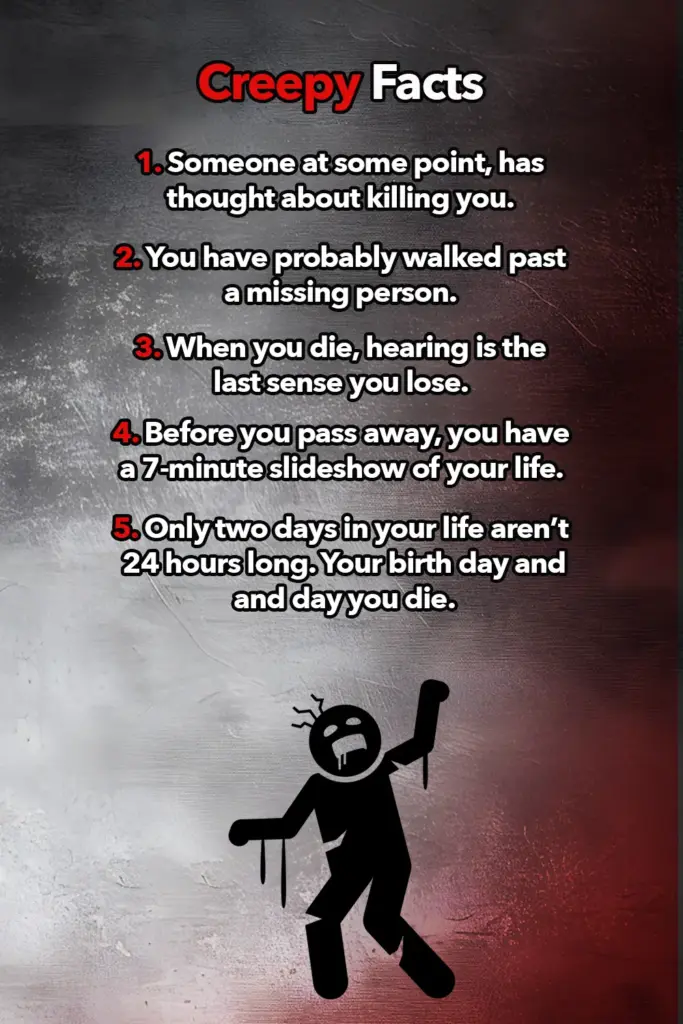
You’ve probably seen the list. Someone at some point has thought about killing you. You have walked past a missing person. When you die, hearing is the last sense to go. Before you pass, your life flashes by in a slideshow. And only two days of your life aren’t 24 hours long.
These circulate as screenshots, usually with no source attached. So I did what I always do: I went looking for the primary research instead of the repost. Some of the claims hold up remarkably well. Others are half-true, and one is simply wrong. Here are 21 genuinely creepy facts, each one checked against the study, textbook, or official record behind it — plus a note on where the science is still arguing with itself.
Table of Contents(Click to Toggle)
- Why Verified Creepy Facts Beat Screenshots
- 21 Creepy Facts, Checked Against the Source
- 1. The “Someone Has Thought About Killing You” Claim
- 2. You Have Almost Certainly Walked Past a Missing Person
- 3. Hearing Is Often the Last Sense to Fade
- 4. The “Life Flashes Before Your Eyes” Phenomenon
- 5. Only Two Days of Your Life Aren’t 24 Hours
- 6. Your Brain Edits Out Your Own Nose
- 7. You Are Blind for Part of Every Eye Movement
- 8. Your Body Is Mostly Not You
- 9. The Smell of Rain Has a Name
- 10. You Have Already Forgotten Most of Your Childhood
- 11. Your Stomach Has Its Own Nervous System
- 12. Some People Hear a Sound That Doesn’t Exist
- 13. You Can Smell Fear, Sort Of
- 14. Your Memory Rewrites Itself Every Time You Recall It
- 15. The “Doorway Effect” Is Real
- 16. Your Eyes Have a Blind Spot You Never Notice
- 17. Faces You See in Dreams Are Usually Real
- 18. You Are Slightly Taller in the Morning
- 19. Your Skin Replaces Itself Roughly Monthly
- 20. Silence Has a Sound in Soundproof Rooms
- 21. The “Hypnic Jerk” That Wakes You Falling
- Bonus Mentions
- Which Creepy Facts Survive the Check
Why Verified Creepy Facts Beat Screenshots
The reason these facts spread is that they’re short, unsettling, and feel true. The problem is that a fact repeated a thousand times without a citation becomes folklore, not knowledge. Take the claim that only two days of your life aren’t 24 hours long. That one is straightforwardly accurate: your birthday and the day you die are the two dates the calendar treats differently, and everything between them is a standard solar day. But the claim that hearing is definitively the last sense to go is more contested than the memes suggest — researchers have documented hearing activity near death, yet pinning down the exact order senses fail is genuinely difficult.
That distinction matters. A creepy fact you can trace to a journal, a textbook, or an official record is more interesting than one you can’t, because you can repeat it without being corrected. So below, each item gets a plain-English check.
21 Creepy Facts, Checked Against the Source
1. The “Someone Has Thought About Killing You” Claim : A thought is not an intention
What it is: The most-shared line in the whole list, usually presented as a chilling certainty.
Category: Psychology folklore.
Why it stands out: Intrusive thoughts are extremely common. Studies of intrusive thinking suggest most people experience unwanted, disturbing thoughts regularly, and violent imagery is among them. But an intrusive thought is not a plan, and psychology draws a hard line between the two. The creepier and more accurate version is: almost everyone has had a thought they’d never act on.
Best for: Anyone who wants the nuance behind the screenshot.
2. You Have Almost Certainly Walked Past a Missing Person : The math is uncomfortably plausible
What it is: NamUs, the US National Missing and Unidentified Persons System, is a public database of missing and unidentified people.
Category: Public records.
Why it stands out: Hundreds of thousands of people are reported missing in the US each year, and the vast majority are found quickly. But with that volume against the number of strangers you pass in a lifetime, the odds that at least one was on a missing list at that moment are not zero. NamUs lets you search by state, age, and date — and it’s free.
Best for: People who like their creepy facts with a searchable source.
3. Hearing Is Often the Last Sense to Fade : Supported, with caveats
What it is: The claim that dying people can still hear even when unresponsive.
Category: End-of-life research.
Why it stands out: Small studies measuring brain responses to sound in dying patients have found activity in some participants, which is why clinicians increasingly advise speaking to unconscious patients as if they can hear. It is not settled science — sample sizes are tiny and results vary — but it’s one of the better-supported entries on this list.
Best for: Readers who want to know which claims actually survive review.
4. The “Life Flashes Before Your Eyes” Phenomenon : Documented, not explained
What it is: The reported experience of seeing a rapid replay of memories during a life-threatening event.
Category: Neuroscience.
Why it stands out: Researchers have recorded brain activity in a dying patient that resembled memory recall, and survivors of sudden danger frequently report a slowed sense of time. Whether it’s a genuine “slideshow” or the brain’s attempt to make sense of chaos afterward is still debated. The honest answer: real reports, contested mechanism.
Best for: Anyone who prefers “we don’t know yet” to a tidy answer.
5. Only Two Days of Your Life Aren’t 24 Hours : The one that’s simply true
What it is: Your birthday and your death day are the two dates the clock treats differently.
Category: Timekeeping.
Why it stands out: Not because of physics but because of how we count: the day you’re born is a partial day, and the day you die is a partial day. Every date in between gets a full rotation. Timeanddate’s calculators make the arithmetic visible if you want to check your own numbers.
Best for: The fact you can safely repeat at a dinner party.
6. Your Brain Edits Out Your Own Nose : You can prove it in ten seconds
What it is: Your nose sits in your field of view constantly, yet you don’t see it.
Category: Perception science.
Why it stands out: Close one eye and a nose shape appears at the edge of vision. Your brain suppresses it because it never changes and carries no new information. The same mechanism explains why you stop noticing a watch on your wrist.
Best for: A party trick that takes no equipment.
7. You Are Blind for Part of Every Eye Movement : Saccadic suppression
What it is: During the quick jumps your eyes make while reading or scanning, vision briefly dims.
Category: Vision research.
Why it stands out: If your eyes streamed continuous images during movement, the world would smear like a bad video. So the brain mutes input during the jump. You never notice the gaps because memory fills them in.
Best for: People who like knowing their own hardware is glitchy.
8. Your Body Is Mostly Not You : The microbial majority
What it is: Bacteria, fungi, and other microbes living on and in you outnumber your own cells.
Category: Microbiology.
Why it stands out: The often-quoted “10 to 1” ratio has been revised downward in recent estimates, but the direction holds: a large share of what you call your body is other organisms. They help digest food and train your immune system. The creepiness fades once you realize you’d struggle without them.
Best for: Readers who like a fact that got more accurate over time.
9. The Smell of Rain Has a Name : Petrichor
What it is: The earthy scent after rain, produced partly by plant oils and soil bacteria.
Category: Earth science.
Why it stands out: The word “petrichor” was coined in a 1964 paper in Nature. The smell comes from oils plants release during dry spells plus a compound made by soil bacteria, both lifted into the air by falling droplets. You can smell it before rain arrives.
Best for: Anyone who’s ever stepped outside and known.
10. You Have Already Forgotten Most of Your Childhood : Childhood amnesia
What it is: Adults typically recall almost nothing before age three or four.
Category: Developmental psychology.
Why it stands out: It isn’t that memories were deleted — the brain structures that lay down lasting autobiographical memory simply weren’t finished. What you “remember” from very early childhood is often a story someone told you.
Best for: People who argue about childhood memories at family dinners.
11. Your Stomach Has Its Own Nervous System : The enteric system
What it is: A dense network of neurons lining your gut, sometimes called the “second brain.”
Category: Physiology.
Why it stands out: It can coordinate digestion without input from your head. That does not mean your gut makes decisions — claims about gut feelings solving problems are overstated — but it does mean “trust your gut” has more anatomy behind it than you’d expect.
Best for: People who want the real version of a popular claim.
12. Some People Hear a Sound That Doesn’t Exist : Musical ear syndrome
What it is: Hearing music or tones with no external source, often linked to hearing loss.
Category: Audiology.
Why it stands out: When the ears stop sending full input, the brain sometimes fills the silence. It’s more common in older adults and usually benign, though it’s worth mentioning to a doctor. The genuinely eerie part is how ordinary it is.
Best for: Anyone curious about how perception handles gaps.
13. You Can Smell Fear, Sort Of : Chemical signals in sweat
What it is: The idea that humans detect stress signals from others’ sweat.
Category: Social neuroscience.
Why it stands out: Studies have found that people can distinguish sweat collected during stressful situations and that it can influence how they judge faces. The effect is subtle, not a superpower, and some results haven’t replicated cleanly. Still, it’s a real research area.
Best for: Readers who like a fact with an asterisk.
14. Your Memory Rewrites Itself Every Time You Recall It : Reconsolidation
What it is: Retrieving a memory can make it temporarily editable before it’s stored again.
Category: Memory research.
Why it stands out: This is why two people can remember the same event differently and both be sincere. Every retelling is a small rewrite. The creepiest implication: your clearest memories may be the ones you’ve rehearsed most, not the ones that happened most accurately.
Best for: Anyone who’s lost an argument about “what really happened.”
15. The “Doorway Effect” Is Real : Why you forget why you walked in
What it is: Walking through a doorway can make you forget your purpose.
Category: Cognitive psychology.
Why it stands out: Experiments in virtual environments found that passing through a doorway increases forgetting, likely because the brain treats the new room as a new “event” and files the old context away. It’s not your memory failing — it’s your memory working as designed.
Best for: Justifying the walk back to the kitchen.
16. Your Eyes Have a Blind Spot You Never Notice : The optic disc
What it is: A small area of each retina with no light receptors, where the optic nerve exits.
Category: Ophthalmology.
Why it stands out: You can find it with a simple dot test on paper. Your brain fills the gap using surrounding detail, so the world looks seamless. The unsettling part isn’t the hole — it’s how confidently your brain hides it.
Best for: A five-minute experiment you can do at a desk.
17. Faces You See in Dreams Are Usually Real : Mostly true, loosely sourced
What it is: The claim that your dreaming brain can’t invent a new face.
Category: Sleep science.
Why it stands out: The brain does reuse faces it has seen, and you’ve seen thousands. But the confident version — “every face is someone you’ve met” — has no solid study behind it. Treat it as a plausible idea, not a finding.
Best for: People who want to know where the line is.
18. You Are Slightly Taller in the Morning : Spinal compression
What it is: The discs in your spine compress during the day and re-expand overnight.
Category: Biomechanics.
Why it stands out: The difference is small — typically under two centimeters — but measurable. Astronauts can grow even more in microgravity. It’s the rare creepy fact with an easy at-home check: measure before bed and again after waking.
Best for: Data-minded readers with a tape measure.
19. Your Skin Replaces Itself Roughly Monthly : The turnover cycle
What it is: Skin cells constantly shed and are replaced from below.
Category: Anatomy.
Why it stands out: The commonly cited cycle is about 28 days for the epidermis, though it slows with age. Most household dust is partly shed skin — a fact that sounds horrifying until you realize it’s just biology doing maintenance.
Best for: Anyone who likes facts that explain their dusting.
20. Silence Has a Sound in Soundproof Rooms : You hear your own body
What it is: In an anechoic chamber, people report hearing their heartbeat, blood flow, and a faint high tone.
Category: Acoustics.
Why it stands out: With no external sound, your auditory system turns up its gain and picks up internal noise. Some visitors find it peaceful; others find it deeply unnerving. Either reaction is normal.
Best for: Readers who want to know what quiet actually sounds like.
21. The “Hypnic Jerk” That Wakes You Falling : A sleep-startle
What it is: The sudden muscle twitch as you drift off, often paired with a sensation of falling.
Category: Sleep neurology.
Why it stands out: It’s very common and generally harmless. One theory is that as muscles relax, the brain misreads the signal as falling and jolts you awake. It’s the closest most of us get to a nightly haunted-house effect.
Best for: Anyone who’s ever jerked awake on a sofa.
Bonus Mentions
Snopes : The fact-checker for viral claims
What it is: A long-running independent fact-checking site.
Category: Verification.
Why it stands out: When a creepy fact arrives as a screenshot, this is where to start. It cites sources and shows its reasoning, so you can judge the claim yourself.
Best for: Before you forward anything.
Retraction Watch : When studies get withdrawn
What it is: A database tracking retracted scientific papers.
Category: Science transparency.
Why it stands out: Some viral facts rest on studies that were later retracted. This site lets you check whether the paper behind a claim still stands.
Best for: Deep-checking a fact you love.
Guinness World Records : Verified extremes
What it is: The official record of measurable extremes.
Category: Records.
Why it stands out: Every entry is documented, which makes it a reliable source for the “longest, oldest, most” style of creepy fact.
Best for: Facts that need an official stamp.
Library of Congress : Primary documents, free
What it is: The largest library in the world, with huge digitized collections.
Category: Archives.
Why it stands out: Newspaper archives and historical records let you trace a “creepy fact” back to its first appearance — often decades earlier than the meme.
Best for: History-flavored creepy facts.
Google Scholar : Find the actual paper
What it is: A search engine for academic literature.
Category: Research.
Why it stands out: Paste a claim’s key phrase and you’ll often find the original study, including its abstract and sample size — which is where the caveats usually live.
Best for: Anyone who wants to read past the headline.
Which Creepy Facts Survive the Check
The pattern here is worth noting. The facts that held up — the two non-24-hour days, the doorway effect, the blind spot, the morning height — are usually the ones with a clear mechanism you can test yourself. The ones that wobble — the definitive “last sense,” the invented-face claim, the certainty that someone has thought about killing you — tend to be the ones where a real finding got stretched into a scarier version.
That doesn’t make them less interesting. It makes them better, because a creepy fact you can defend is one you can share without being corrected. Check it twice, then share it.
Which of these surprised you most — and have you found a creepier one with a real source behind it? Tell me in the comments.

Marta writes about the everyday facts people repeat without checking, from kitchen science to common sayings. Her angle is simple: find the original source, show what it actually says, and explain where the popular version drifted. She favors short pieces that end with a clear takeaway you can use the next time the topic comes up.